Syncretic Hydro Aqua Futurism
Academic Module
Open Elective
2Weeks
2023

Innovation in Aquatic Technologies
This could involve developing advanced technologies for water purification, desalination, aquaculture, and other emerging areas related to water.
“Syncretic Hydro Aqua Futurism” is a speculative concept proposing an integrated, forward-looking approach to water management. It explores the blending of diverse ideas and technologies, encouraging cross-disciplinary collaboration while emphasizing cultural and environmental harmony in addressing future water-related challenges.
Cultural and Environmental Harmony
The concept integrates cultural perspectives into future water-management practices, aiming to create a more balanced and harmonious relationship between people, water, and the environment.

Tracing Sabarmati River
or one week, we explored the Sabarmati riverfront entirely on foot, covering nearly 22 kilometers to closely observe the condition of the river and its surrounding ecosystem. Walking through different stretches helped us document changes in water quality, surface texture, waste accumulation, sound, and human activity, building a deeper sensory and emotional understanding of the river beyond surface-level research.
This slow, immersive exploration revealed subtle patterns of pollution, stagnation, and ecological imbalance.
These observations later became important in shaping the spatial and sensory experience of the installation.

Finding Local Dead Zones
In Ahmedabad, we travelled from Point A to Point B, exploring different water bodies and locations along the way. The study focused on observing water quality and the surrounding environment while examining soil and plant conditions to understand the ecological health and fertility of each area.
Underwater Dead Zones
Underwater dead zones are areas where oxygen levels become extremely low, making them difficult or impossible for aquatic life to survive. They are often linked to excessive nutrient pollution caused by human activities.
Read more


Dead zones occur because of a process called eutrophication.
Eutrophication is a process where water bodies receive high concentrations of nutrients, often nitrogen and phosphorus, leading to excessive plant and algal growth.


Excessive nutrient levels, particularly nitrogen and phosphorus, act as a key trigger for HABs. These nutrients may come from sources such as agricultural runoff, industrial discharges, and wastewater. As nutrient levels in the water increase, they encourage the growth of plants and algae, creating an abundant food supply.
As harmful algae thrive in nutrient-rich environments, they can outcompete other, less harmful species. This dominance results in a shift in the composition of the algal community within the water body.
2016
2011


Wastewater Disposal
Soil Erosion and Sedimentation
Increased Human Activities
Key Factors
Why a Sensory Symposium?
While researching underwater dead zones across Gujarat’s water bodies, we realised that ecological collapse often remains invisible to the public. Although scientific data and reports explain the crisis, they rarely create an emotional connection or sense of awareness.
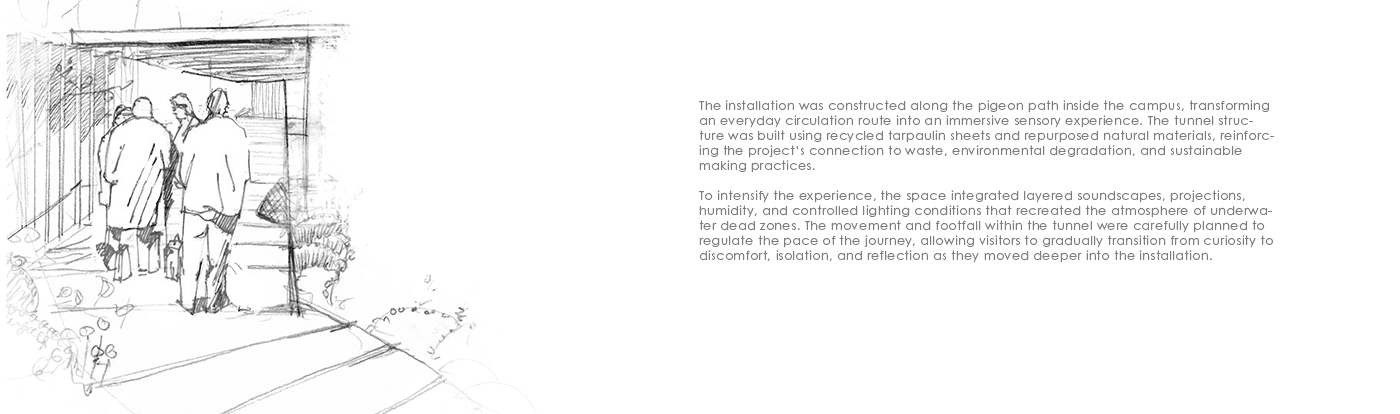
In response, we designed a sensory symposium—an immersive tunnel installation that translates underwater dead zones into a bodily experience through darkness, restricted movement, industrial sounds, humidity, and decaying smells. The installation uses sensory architecture to recreate feelings of suffocation, stagnation, and isolation, allowing visitors to physically experience the invisible consequences of pollution and environmental neglect.